CISO Budget 2026: How to Estimate NIS2 Human Compliance Costs in CAPEX
A guide for CISOs on planning the CISO budget 2026. Learn to break down NIS2 human compliance costs: HCRM platform licensing, training, and CAPEX ROI.

The deadline for implementing the NIS2 Directive is approaching, imposing a structural change on corporate cybersecurity across Europe. This regulation transcends technical compliance; it redefines cybersecurity as a critical business function and an indelegable responsibility of the Board of Directors.
Consequently, preparing the CISO budget 2026 necessitates transcending conventional hardware and software to address the dominant variable: human risk. To defend this investment, it is crucial to understand the detailed obligations of the directive and accept that executive personal responsibility is no longer delegable.
Understanding executive personal responsibility under NIS2 is essential to grasping why this budget is now a direct concern for the Board, as failure to comply can lead to personal liability and temporary disqualification from management roles.
This guide will help you quantify and defend this strategic asset (CAPEX) within your CISO budget 2026, ensuring you can manage compliance and mitigate potential NIS2 costs while demonstrating due diligence.
Why Human Risk is a CAPEX Investment (Not OPEX)
Traditionally, cybersecurity training has been considered an Operating Expense (OPEX): a recurrent cost with an impact that is often difficult to measure. However, this approach is obsolete. When planning your CISO budget 2026, investing in a Human Cyber-Risk Management (HCRM) platform must be structured as a Capital Expenditure (CAPEX) to offset long-term NIS2 costs, similar to a Next-Gen Firewall.
Why? Because an HCRM platform is not a cost that is "consumed"; it is an asset that builds long-term resilience.
- From Reaction to Strategic Prevention: Instead of spending resources on remedying incidents, the shift-left approach drives us to invest in prevention. An HCRM platform serves as the linchpin of this proactive posture, transforming the workforce into a proactive and measurable defense system. This shift allows you to reallocate resources from reactive technologies to continuous human prevention, optimizing the CISO budget 2026 and drastically reducing the potential NIS2 incident costs. Adopting a comprehensive Human Cyber-Risk Management strategy allows you to understand how this asset differs from legacy training tools.
- Amortization of the Digital Asset: An HCRM platform generates demonstrable value year after year. It reduces the human attack surface, automates training, and simplifies compliance reporting, freeing up manual work hours for the security team. This digital asset amortizes through direct reductions in operational and NIS2 costs—fewer incidents, lower premiums, and avoided fines—aligning with Gartner’s framework on IT business value for CAPEX investments.
Breakdown of Costs for Your 2026 Budget
To articulate a convincing funding proposal in the CISO budget 2026, it is fundamental to break down the NIS2 costs associated with human risk into three key areas. This structure allows you to justify every euro allocated in your CISO budget 2026 as a direct investment in resilience and controlling NIS2 costs.
HCRM Platform Licensing
The Human Cyber-Risk Management platform will function as the foundational pillar of your defense architecture. When evaluating vendors, look beyond the price tag; analyze the licensing model (is it per active user? by module?) and its capacity to scale with your organization. Ensure that key functionalities—simulations, training, analytics, and reporting—are included to avoid hidden NIS2 costs or unexpected add-ons. Use a checklist to evaluate vendors and guarantee the solution aligns with your long-term technical and compliance needs.
Investment in Training and Attack Simulation
Security awareness training has evolved from a static annual obligation into a continuous defensive capability. Your CISO budget 2026 must account for the cost of designing and implementing effective attack simulations and awareness campaigns that prepare your teams for current tactics. This includes a diverse content catalog covering:
- Emerging threats such as AI-phishing, smishing, and quishing. Account for emerging vectors detailed in our analysis of current phishing trends like AI-phishing and Qrishing to justify the budget for these advanced threats.
- Complex social engineering attacks, such as voice fraud and deepfakes. Allocate resources for complex scenarios, such as vishing and deepfake voice fraud, which require specialized defense strategies.
- Personalized campaigns for the highest-risk segments within your company.
The Value of an Integrated Platform
Finally, the platform cost is justified by its centralization capability. An integrated HCRM solution reduces Total Cost of Ownership (TCO) and administrative NIS2 costs by unifying management, metrics analysis, and reporting. This not only saves countless hours of manual work for your team but also provides a single, coherent view of human risk, essential for demonstrating the due diligence required by ENISA guidelines on NIS2.
Aligning HCRM Investment with NIS2 Requirements
Justifying the investment in an HCRM platform within your CISO budget 2026 becomes a matter of regulatory logic when mapped directly with the articles of the NIS2 Directive. This is not an optional upgrade, but a strategic mechanism to fulfill legal obligations and minimize NIS2 costs arising from non-compliance penalties.
Article 21: Mandatory Training and Risk Assessment
Article 21 is unequivocal: it requires "cybersecurity training" for everyone, from staff to senior management. An HCRM platform automates and evidences the delivery of this continuous training, ensuring your CISO budget 2026 efficiently covers Article 21 mandates.
This goes far beyond an annual course. It involves implementing a comprehensive approach that adjusts to each employee's risk profile, ensuring training is pertinent and measurable. For a complete roadmap on how these tools fit into the interconnected compliance framework, refer to our compliance manual for NIS2, ISO 27001, and DORA. Knowing the legal framework is fundamental to deploying simulations with total legal security.
Article 20: Governance and Management Body Responsibility
Article 20 enforces strict governance mandates: the management body is now responsible for supervising and approving cybersecurity risk management measures. How can they do this without reliable data?
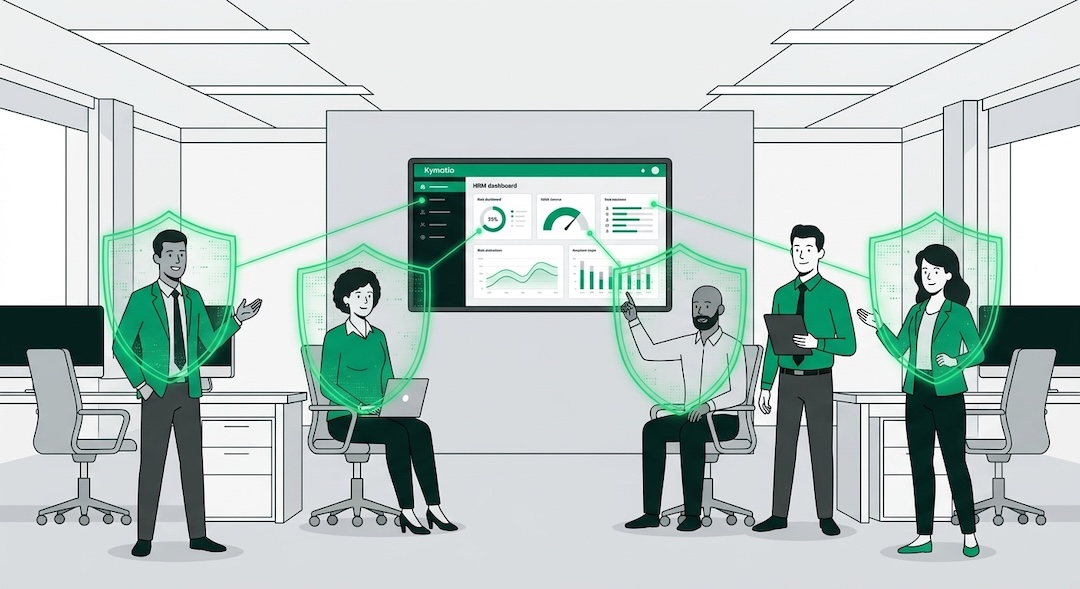
Here, the HCRM investment demonstrates its value for governance and business strategy. The platform's dashboards and reporting provide the Board with the metrics necessary to prove their due diligence, translating operational data into a clear view of human risk levels.
- Audit Readiness: Your budget must cover the capability to generate specific audit evidence instantly. Consult our guide on NIS2 audit evidence to understand the exact logs, training records, and KPIs you are paying for.
- Regulatory Source: You can review the specific obligations in the official text of the Directive (EU) 2022/2555 (NIS2).
Measuring ROI: The Business Case for the Board
Once the investment in your CISO budget 2026 is justified, the next step is to demonstrate its value. The true Return on Investment (ROI) for your CISO budget 2026 is measured through the neutralized threat: incidents that are preemptively neutralized. The management doesn't just want to see compliance; they want to see quantifiable results.
Quantifying Avoided Risk
The KPIs offered by an HCRM platform (reduced click rates, increased threat reporting, lower detection time) are the basis for calculating ROI. These data allow you to estimate the NIS2 costs associated with an avoided incident, which constitutes the central thesis of your business case. The calculation is straightforward:
ROI=HCRM Platform Cost / (Cost of Avoided Incident−HCRM Platform Cost)
To refine this calculation, it is key to apply advanced segmentation. Apply a phishing simulation masterplan to calculate ROI by department or risk profile, demonstrating direct impact on high-priority areas.
Metrics for Management: From Operational KPIs to Human Risk Score
While your team requires granular telemetry, the C-Suite demands a high-fidelity, consolidated perspective. Therefore, the ability to translate hundreds of data points into a Human Risk Score is fundamental. This single indicator simplifies communication, demonstrates continuous improvement, and facilitates strategic decision-making.
By utilizing advanced KPIs and dashboards for human risk, you can move from reporting problems to demonstrating the maturity of your human defense. Furthermore, planning with a structured annual campaign calendar ensures that your investment yields measurable results throughout the financial year.
Frequently Asked Questions


You should estimate the Total Cost of Ownership (TCO) by summing three key areas: HCRM platform licensing (per user), continuous content production (simulations and adaptive training), and the operational resources required for analysis and reporting to the Board.
Under NIS2, management bodies can be held personally liable for non-compliance. Penalties may include temporary bans from managerial functions and significant administrative fines, making cybersecurity oversight an indelegable legal duty for the C-Suite.
Yes. Article 21 explicitly requires entities to provide regular cybersecurity training to all employees and—crucially—to members of the management body (C-Suite) to ensure they can supervise risk management measures effectively.
To prove due diligence, you must provide traceable logs of training completion, attack simulation results, and specific records of management body training. An HCRM platform automates the generation of these compliance reports for auditors.
Unlike OPEX (consumable expenses), an HCRM platform is a long-term asset that builds organizational resilience. It amortizes over time by reducing future operational costs, lowering insurance premiums, and mitigating the financial impact of potential cyber incidents.
Article 20 mandates that the management body approve and supervise risk measures. An integrated HCRM platform supports this by providing dashboards and "Human Risk Scores" that translate technical data into understandable metrics for strategic decision-making.



Join the Kymatio® newsletter and get the latest insights, research, and practical tips on cybersecurity awareness prevention straight to your inbox.