Calculating the ROSI of Vishing: The Financial Impact of Voice Fraud Prevention
Learn how to calculate the Return of Security Investment (ROSI) for voice fraud prevention. Secure your compliance evidence under NIS2 Article 20.
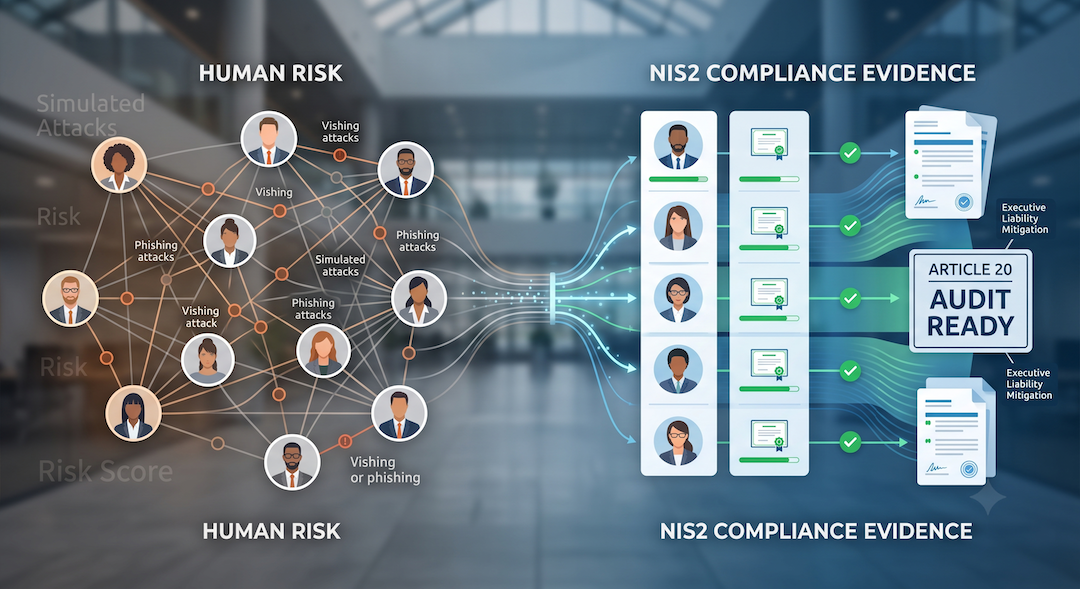
Voice fraud under the NIS2 Directive elevates social engineering to a severe corporate liability, where a single successful exploit triggers financial penalties and direct personal executive suspensions. Proactively managing this threat through automated Human Risk Management (HRM) establishes a clear, quantifiable vishing prevention value by neutralizing AI-driven voice deception before it breaches corporate infrastructure. Failing to secure voice communication channels directly inflates the overall cost of data breach and leaves the boardroom legally exposed.
Under the regulatory requirements of NIS2, corporate governance must treat cybersecurity as a structural priority because human risk is business risk. Threat actors deploy advanced vishing tactics targeting corporate collaborators, exploiting psychological triggers to bypass legacy perimeters. When organizations fail to field active defensive measures against these targeted attacks, they fail to demonstrate the due diligence required under Article 20, leading to unmitigated operational and compliance risks.
To protect organizational resilience, security leaders must move past passive tools and establish an active culture of security. Analyzing the operational mechanics of voice fraud and deepfake vulnerabilities directly enables security leaders to evaluate baseline exposure, compress organizational vulnerability, and maximize mid-year cybersecurity ROSI.
Quantifying the Financial Threat: The True Cost of Data Breach via Vishing
The total cost of data breach driven by voice fraud extends far beyond immediate capital loss, directly undermining your security investment ROI by compounding regulatory penalties, incident forensics, and severe operational disruption. Quantifying these specific layers of corporate exposure allows security leaders to establish a baseline vishing prevention value that protects enterprise valuation. Without proactive behavioral countermeasures, a single voice compromise under the NIS2 regime can jeopardize compliance posture and trigger structural executive liability.
Deepfake Voice Cloning as a Corporate Threat Vector
Malicious actors now leverage generative AI to manufacture high-fidelity voice clones that precisely replicate leadership. By deploying these synthetic identities in real-time phone calls, attackers bypass traditional technical perimeters to authorize fraudulent financial transfers or harvest strategic credentials. According to data from the ENISA Threat Landscape Report, identity manipulation and targeted social engineering continue to heavily impact European corporate resilience. These evolving attack methods force CISOs to determine how to reduce the cost of data breach while establishing what tools do I need to assess digital human risk when legacy authentication defenses fail.
The Multi-Layered Expense of Voice Fraud Compromise
Evaluating the true financial implications of human risk requires assessing the aggregated expenses that hit the balance sheet following a successful vishing incident:
- Direct Capital Theft: Immediate cash depletion from unauthorized, fraudulent wire transfers and diversions.
- Regulatory Non-Compliance Fines: Heavy financial penalties levied by authorities for failing to implement due diligence and human risk controls under NIS2.
- Forensics and Remediation Fees: The technical overhead of hiring specialized incident response teams to contain data leaks and trace credential compromises.
- Operational Downtime: Lost productivity during system restoration alongside severe long-term reputational erosion among European clients.
Demystifying the Cybersecurity ROSI Formula for Human Risk Management
Calculating cybersecurity ROSI translates qualitative human risks into precise financial metrics to justify defensive budgets directly to the board. By applying a standardized ROSI formula, security leaders can quantify the exact monetary losses prevented by automated voice simulations to clarify their baseline cybersecurity ROSI. This financial validation proves that proactive behavioral engineering delivers a measurable economic return rather than acting as a sunk corporate cost.
What is the Cybersecurity ROSI Formula for Voice Fraud?
Question: How do you calculate cybersecurity ROSI for vishing prevention?
Answer: Calculate cybersecurity ROSI by multiplying the Annualized Rate of Occurrence (ARO) by the Single Loss Expectancy (SLE) to find total exposure, applying the simulation mitigation rate, subtracting the solution cost, and dividing by the solution cost.
ROSI = (SLE x ARO x Mitigation Rate) - Solution Cost / Solution Cost
Breaking Down the Variables: SLE, ARO, and Solution Effectiveness
To mathematically demonstrate your security investment ROI and calculate an accurate ROSI formula, you must map your operational data against standard economic models. Aligning with advanced frameworks like the NIST guidelines on economic modeling for security investments requires a systematic calculation process. CISOs frequently ask: what tools do I need to assess digital human risk and calculate an accurate ROSI formula?
You can establish this financial visibility through four distinct metric steps:
- Single Loss Expectancy (SLE): Compute the total monetary impact of a single successful vishing incident, factoring in direct capital theft, forensic mitigation fees, and NIS2 non-compliance fines.
- Annualized Rate of Occurrence (ARO): Estimate the frequency of targeted voice fraud attempts directed at your collaborators over a twelve-month period based on historical telemetry.
- Mitigation Rate (Solution Effectiveness): Calculate the empirical percentage reduction in collaborator vulnerability achieved through automated social attack simulations.
- Solution Cost: Total annual capital expenditure required to deploy and maintain the active Human Risk Management (HRM) platform.
By structuring these variables, security leaders shift from defensive assumptions to empirical risk modeling, clearly proving the financial value of security to executive shareholders.
Error Reduction Metrics: Measuring Vishing Prevention Value
Measuring the vishing prevention value of a corporate security program requires tracking objective error reduction metrics that prove a verifiable shift from systemic vulnerability to active organizational resistance. Enterprises evaluate this progression by tracking exact error reduction metrics across consecutive quarters while monitoring how quickly collaborators flag synthetic voice threats to maximize overall vishing prevention value. Documenting these tangible operational improvements translates human behavior into financial data, establishing an empirical justification for your security investment ROI.
Tracking Failure Rates in Social Attack Simulations
To move past passive, compliance-driven checkboxes, security leaders must continuously audit how well employees resist live psychological engineering. How does NIS2 impact corporate governance and collaborator risk? It requires corporate officers to actively quantify human vulnerability and implement measurable, risk-based countermeasures.
By deploying structured, automated targeted voice phishing simulations, organizations can baseline and track real-time response rates to sophisticated voice deception. For instance, historical campaign data shows that executing a continuous simulation workflow can successfully drive an organization's internal user failure rate down from 28% to just 6% within a six-month period.
The Velocity of Detection and Internal Reporting
True behavioral resilience is defined by the speed at which threat telemetry is generated by your workforce. Aligning your operations with the Gartner risk management framework means capturing behavioral metrics that look far beyond binary click or capture rates.
CISOs must actively measure the reporting velocity—the exact time elapsed from the initial vishing contact to the moment a collaborator submits an internal alert. Accelerating this detection pipeline enables collaborators to act as a proactive security perimeter, neutralizing active social exploits before they can expand into an enterprise-wide data compromise.
Avoided Breach Costs: Protecting the C-Suite from NIS2 Liabilities
Avoided breach costs under the NIS2 framework are directly tied to eliminating the catastrophic expenses of regulatory fines and preventing the personal legal liability of corporate directors. Implementing automated human risk metrics allows European executive boards to mitigate targeted vishing compromises while verifying security investment ROI. This proactive stance protects the C-suite from direct administrative sanctions and temporary operational disqualification.
Article 20 Compliance and Personal Executive Liability
How does NIS2 impact employee management and executive accountability? According to the official European Union Directive text for NIS2, governance bodies are now legally accountable for implementing and supervising risk management measures. NIS2 legally terminates technical delegation, enforcing direct personal consequences for CEOs and board members—including temporary management bans—if an organization fails to demonstrate active due diligence after an incident. This structural shift elevates avoided breach costs from a purely technical metric to an indispensable shield for corporate leadership.
Building a Defensible Audit Trail with Human Risk Metrics
To protect the board, security leaders must replace legacy questionnaires with an active, automated compliance defense. Organizations can maintain a defensible audit trail during regulatory reviews by following a strict risk-mitigation workflow:
- Supervise Risk Mitigation: Continuously track behavioral vulnerability data rather than relying on static policies.
- Enforce Mandatory Training: Provide adaptive, automated simulations to condition corporate collaborators against voice fraud.
- Demonstrate Due Diligence: Use real-time reporting to prove to regulators that the organization actively measures and mitigates human vector vulnerabilities.
By institutionalizing this data-driven strategy, companies can easily review the personal liability of board members and secure a robust defensive baseline.
Securing Your Security Investment ROI with Kymatio
Securing a measurable security investment ROI against voice fraud requires transitioning from static awareness tactics to automated, continuous social attack simulations. By quantifying human behavioral vulnerabilities, organizations can definitively prove their cybersecurity ROSI while meeting the strict risk management requirements of the NIS2 Directive.
Managing digital human risk directly protects corporate valuation and safeguards executive leadership against legal liability under governance frameworks. Deploying targeted vishing and phishing simulations provides the exact automated risk quantification metrics required to turn human exposure into measurable defensive telemetry. Elevate your corporate posture and build a defensible compliance framework by aligning your organization with our comprehensive simulation masterplan today.
Frequently Asked Questions


Cybersecurity ROSI measures the financial efficiency of a security control by comparing total avoided breach costs against the net deployment and subscription costs of the implemented Human Risk Management (HRM) platform.
Vishing leverages high-fidelity AI voice cloning to bypass legacy technical perimeters through corporate collaborators. A successful attack directly inflates the cost of data breach via immediate capital theft, forensic overhead, and severe NIS2 non-compliance fines.
Clear vishing prevention value is established through objective error reduction metrics. These track the continuous drop in simulation failure rates alongside a measurable increase in the reporting velocity of corporate collaborators.
The directive removes technical delegation, making board executives personally accountable. Proactive voice fraud prevention drives avoided breach costs by eliminating the risk of corporate administrative fines and personal management suspension sanctions.
No. Passive, static modules fail to build behavioral resilience against real-time voice cloning. Effective mitigation requires automated social attack simulations that actively condition collaborators to detect psychological triggers during live phone interactions.
Multiply the total financial exposure of a successful voice compromise by the annualized rate of occurrence (ARO), then apply the empirical risk mitigation rate achieved through continuous simulation workflows.




Join the Kymatio® newsletter and get the latest insights, research, and practical tips on cybersecurity awareness prevention straight to your inbox.