Insurance Sector & DORA: Mastering New Operational Resilience Requirements
Master DORA compliance in the insurance sector. Learn how EIOPA guidelines and operational resilience reshape Human Risk Management for executives.

Human risk is business risk, and across regulated financial markets, managing digital integrity is an active cornerstone of corporate governance rather than a static compliance formality. Achieving DORA compliance for the insurance sector redefines financial security by requiring insurers and critical ICT providers to actively neutralize behavioral vulnerabilities and social engineering threats. Boards must recognize that a single compromised credential can disrupt vital business operations across the entire financial supply chain.
For C-suite executives, CISOs, and risk officers, this regulation introduces a definitive operational transition from reactive containment to a quantifiable security culture. Analyzing regulatory intersection points within the DORA and NIS2 frameworks highlights why boards must capture automated evidence of compliance to prevent disruptive business consequences like executive liability. Managing this operational shift requires a data-driven strategy backed by predictive risk insights and a structured regulatory compliance manual that translates operational metrics into executive risk indicators.
True operational resilience cannot be achieved through passive training classrooms or unmeasurable annual courses that fail to alter daily habits. Empowering collaborators through ongoing behavioral engineering and active simulations is the only strategic defense that guarantees business continuity and satisfies supervisory expectations during rigorous audits.
Understanding the DORA Framework and EIOPA Guidelines for Insurers
DORA compliance in the insurance sector requires board members to assume ultimate legal liability for digital operational resilience, transforming risk management from an isolated technical task into a core corporate governance priority. Financial entities must auditably certify they possess the active capabilities to withstand, respond to, and recover from severe ICT-related disruptions and advanced social engineering vectors. Supervisors will no longer accept passive bullet points; they demand continuous, documented proof of a resilient infrastructure.
Scope of Application: Financial Entities and Critical ICT Providers
Achieving strict DORA compliance standard for insurance companies targets the entire financial ecosystem, meaning insurance undertakings, reinsurance firms, and intermediaries must structurally anchor these regulations into their core operational resilience strategy. Executive boards must internalize that outsourcing core systems to cloud providers does not outsource legal accountability; the management body retains full, non-delegable oversight responsibilities. This regulatory boundary forces insurers to continuously audit the behavioral patterns of their collaborators and actively monitor their extended digital supply chain to prevent single points of failure from threatening systemic stability.
Aligning National Oversight with EIOPA Expectations
National competent authorities enforce compliance through the strict lens of the EIOPA guidelines. To satisfy the specialized technical criteria defined within the EIOPA guidelines and remain aligned with the official DORA Regulation (EU) 2022/2554 mandates, financial firms must embed continuous compliance metrics directly into their digital operational resilience architecture:
- Comprehensive ICT Risk Management: Establishing perpetual asset identification, mapping critical business dependencies, and deploying predictive mitigation paths to counter evolving threat behaviors.
- Governance and Incident Reporting: Implementing early-warning classification protocols to detect anomalies and leveraging automated workflows to report major operational breaches within tight regulatory windows.
- Digital Resilience Testing Regimes: Conducting regular technical vulnerability assessments paired with automated Social Attack Simulations to benchmark actual workforce readiness against sophisticated deception.
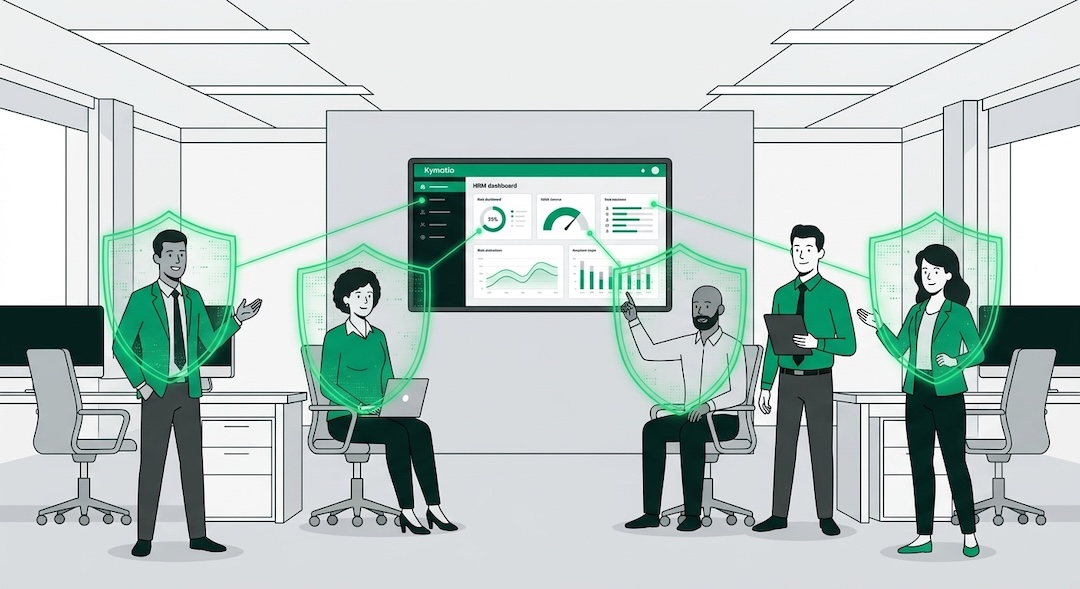
Proving due diligence during a regulatory inspection requires presenting live dashboards, auditable behavioral metrics, and clear indicators of continuous risk reduction. Positioning these executive insights at the center of the organization's governance structure is the only viable path to protect the enterprise against systemic disruptions and safeguard its market reputation.
Why Human Risk Management is the Core of Digital Operational Resilience
Human risk is business risk, meaning financial institutions cannot achieve true digital operational resilience solely by reinforcing their technical perimeter controls. The DORA framework explicitly recognizes that an organization's capacity to withstand and recover from cyber disruptions depends entirely on the daily security habits of its workforce. Deploying an advanced Human Risk Management strategy is the only proactive way to generate auditable compliance evidence and neutralize behavioral vulnerabilities before an incident occurs.
Financial Exposure Indicator: The latest technical analysis on the threat landscape by ENISA underscores that social engineering remains the primary entry vector for targeted cyberattacks within the financial sector, proving that legacy infrastructure defenses inevitably fail if employee behaviors are left unmonitored.
Moving Beyond Passive Classrooms to Active Security Culture
When considering what tools are needed to evaluate digital human risk, executive leadership must immediately abandon traditional, check-the-box training programs. Static annual courses and unpersonalized video lectures do not alter daily security habits; instead, they overwhelm employees without providing any measurable threat reduction or auditable evidence for regulators.
True operational resilience requires a dynamic, continuous approach to behavioral engineering. By launching automated and adaptive Social Attack Simulations, security teams can accurately measure the real-world probability of a collaborator interacting with a malicious link or disclosing corporate credentials. This ongoing assessment allows organizations to deliver tailored micro-learning pathways based on specific department profiles, transforming operational telemetry into clear risk scores for the board.
Why Legacy "Users" Must Become Empowered Collaborators
To align with modern European security mandates, insurance undertakings must eradicate legacy security perspectives that treat the workforce as an operational liability. Personnel handling sensitive policyholder data and financial assets must be structurally empowered as proactive risk mitigators capable of identifying corporate anomalies early.
Shifting to this proactive model requires real-time risk visibility. Reviewing the empirical data compiled in our insurance sector cybersecurity case study demonstrates how continuous behavioral monitoring and early exposure tracking drastically minimize a company's attack surface. By placing human metrics at the core of the internal control framework, the C-suite secures frictionless compliance, lowers insurance premiums, and hardens corporate resilience against sophisticated fraud.
Business Consequences of Non-Compliance: Board Liability and Fines
Failing to meet DORA compliance mandates carries immediate corporate penalties, including multimillion-dollar administrative fines and the personal disqualification of board directors. European supervisory bodies now hold executive leadership directly liable for systemic oversight failures, making digital resilience a non-delegable fiduciary duty. Boards can no longer obscure their oversight accountability through technical teams when a preventable behavioral breach disrupts critical financial services.
WARNING: Protect your leadership and mitigate your exposure immediately. Under active financial supervision frameworks, corporate directors face personal administrative bans and temporary management exclusions if they fail to prove continuous, diligent monitoring of technical and behavioral infrastructure controls.
Fiduciary Duties and Executive Disqualification
How do regulatory penalties impact corporate directors on a personal level? Under the finalized framework, the management body bears ultimate legal responsibility for digital risk. If an insurer suffers a major operational disruption due to poor corporate ciberhigiene or unmitigated human vulnerabilities, regulators can implement stringent management bans.
This personal liability underscores that human risk is business risk. Executive leadership must actively participate in continuous risk tracking rather than treating compliance as a passive administrative routine. This exposure becomes even more critical as threat actors launch targeted social engineering operations, such as weaponized AI and deepfakes, explicitly designed to manipulate high-level corporate decision-makers. Fiduciary duties now legally require active board involvement in supervising and mitigating workforce vulnerabilities to protect corporate continuity.
Financial Penalties Under the DORA Regulation
What are the direct financial consequences of failing a financial resilience audit? The joint guidelines published in the official ESAs technical standards outline strict penalty structures for non-compliant financial entities and their critical third-party digital suppliers. Regulators can impose periodic penalty payments of up to 1% of the average daily worldwide turnover of the preceding business year.
For standard insurance undertakings, systemic compliance oversight failures lead directly to active enforcement actions. Failing to maintain chronological records of workforce resilience turns unmanaged behavioral risks into severe bottom-line liabilities. Neglecting to secure auditable risk metrics guarantees severe economic sanctions that directly damage organizational market value and shareholder trust.
Strategic Roadmap: Preparing Your Insurance Firm for DORA Audits
To pass a regulatory inspection under the framework of DORA compliance in the insurance sector, firms must implement a roadmap that shifts human risk from subjective approximations to automated behavioral telemetry. Hardening your security perimeter to prove DORA compliance readiness and achieving true operational resilience requires deploying continuous behavioral tracking alongside active testing regimes before auditors arrive. The board must secure auditable records of continuous risk reduction to safeguard executive liability and satisfy competent supervisory authorities.
Implementing Social Attack Simulations for Real-World Metrics
When evaluating what tools do I need to evaluate digital human risk effectively, executive leadership must look past legacy compliance templates. True resilience cannot be quantified by tracking who watched a static video. Instead, security teams must deploy automated Social Attack Simulations that mirror actual deceptive vectors like targeted phishing and vishing campaigns.
To align seamlessly with the supervisory expectations detailed in the official EIOPA guidelines, risk officers must go beyond technical controls and establish an auditable behavioral testing sequence:
- Baseline actual workforce vulnerability profiles across different corporate departments to identify hidden blind spots.
- Launch adaptive, role-specific simulations that replicate highly sophisticated financial fraud.
- Record actionable metrics such as early report rates and data submission frequencies to map internal risk hotspots.
This practical execution ensures administrative controls conform to rigorous international frameworks for verifying human-centric defenses, such as the NIST SP 800-53 standard, turning daily employee behavior into verifiable compliance data.
Building Continuous Evidence and Measuring ROSI
A frequent question among financial compliance officers is: how does NIS2 affect employee management when cross-referenced with financial regulations like DORA? The answer lies in establishing a unified governance model for the workforce. Defending the enterprise against severe systemic disruption requires an uninterrupted stream of behavioral evidence that proves your collaborators are actively blocking threats.
Every ongoing simulation must be executed safely under a clear corporate policy, utilizing a compliant legal framework for phishing simulations that respects strict data privacy mandates. Quantifying this risk reduction enables CISOs to accurately measure the Return on Security Investment (ROSI), transforming behavioral improvement into a strategic financial asset. Presenting these executive KPIs to the board protects directors against personal liability, satisfies supervisory audits, and maintains organizational market value.
Frequently Asked Questions


DORA compliance in the insurance sector refers to the regulatory obligation for insurance and reinsurance undertakings to meet strict European digital operational resilience standards, ensuring they can withstand, respond to, and recover from severe ICT-related disruptions and cyber threats.
DORA applies explicitly to insurance companies, reinsurance undertakings, insurance intermediaries, and critical third-party ICT service providers. It does not apply generically to non-financial regulated companies or small-scale insurance brokers exempt under specific criteria.
EIOPA guidelines provide the specialized technical standards and supervisory expectations used to evaluate an insurance firm’s governance, risk management frameworks, and operational testing methodologies under the broader DORA regulation.
Operational resilience is the continuous ability of an insurer to protect its digital infrastructure, minimize third-party ICT risks, safeguard sensitive policyholder data, and maintain core business continuity during a major cyber incident.
Yes. DORA places ultimate responsibility for ICT risk on the management body. Board members face direct business consequences, including severe administrative fines and temporary disqualification for failing to oversee digital resilience proactively.
Traditional courses offer passive, unmeasurable education. DORA requires quantifiable resilience. Insurers must implement active Human Risk Management (HRM) and continuous social attack simulations to build a documented, auditable security culture.



Join the Kymatio® newsletter and get the latest insights, research, and practical tips on cybersecurity awareness prevention straight to your inbox.