Ransomware in the Insurance Sector: Human Risk Management Lessons from a Major Breach
Analyze a major insurance sector breach and why Human Risk Management is critical for NIS2 and DORA compliance. Strengthen your Human Firewall.

A recent incident involving a major multinational insurer should not be analyzed as a simple technical failure. Regulatory resolutions from authorities such as the Spanish Data Protection Agency (AEPD) reveal a critical breakdown in human risk management. The attacker did not need to breach fortified perimeters; they exploited the remote work environment to capture credentials via malware introduced through phishing.
While diligent response avoided severe penalties, the strategic takeaway is clear: defensive success must not hide the urgent need to evolve toward a Human Risk Management (HRM) strategy to prevent human behavior from remaining the primary entry point.
The Anatomy of Intrusion: Beyond Technical Infrastructure
Threat actors like Ragnar Locker have perfected tactics that bypass traditional defenses: they do not hack systems, they hack the behavior of collaborators. In high-profile insurance breaches, forensic analysis confirms that the incident often begins in the private sphere, leveraging the security gap between home devices and the corporate network.
The vulnerability of large insurers is critical. According to official INCIBE cybersecurity reports, the financial and insurance sectors remain top targets. A typical intrusion follows a methodical escalation:
- Initial Capture: Obtaining credentials from a collaborator accessing remotely from an infected device.
- Access: First entry into the virtual workstation using stolen legitimate identifiers.
- Lateral Movement: Persistent attempts to capture credentials of high-privilege collaborators.
- Critical Escalation: Obtaining domain administrator privileges in record time.
- Execution: Massive distribution of ransomware.
Business Consequences and Compliance (DORA/NIS2)
For a financial entity, the impact is severe, requiring the activation of Business Continuity Plans. Under the current regulatory framework (DORA and NIS2), the bar has been raised. Under Article 20 of the NIS2 Directive, senior management assumes direct legal liability for cybersecurity risk governance.
Organizations must now demonstrate proactive, evidence-based management. The new "due diligence" standard obligates entities to provide constant proof of operational resilience. This includes management bodies receiving awareness instruction and maintaining a NIS2-compliant audit evidence guide.
From Traditional SAT to Human Risk Management (HRM)
Annual training programs fail to address multi-vector threats. Kymatio's HRM replaces uniform learning with the constant measurement of probability and impact, optimizing the ROSI (Return of Security Investment):
- An administrator with access to sensitive data presents a critical human risk scoring due to high confidentiality impact.
- A junior profile represents a moderate risk even with the same probability of error.
How the Human Firewall Protects ROSI
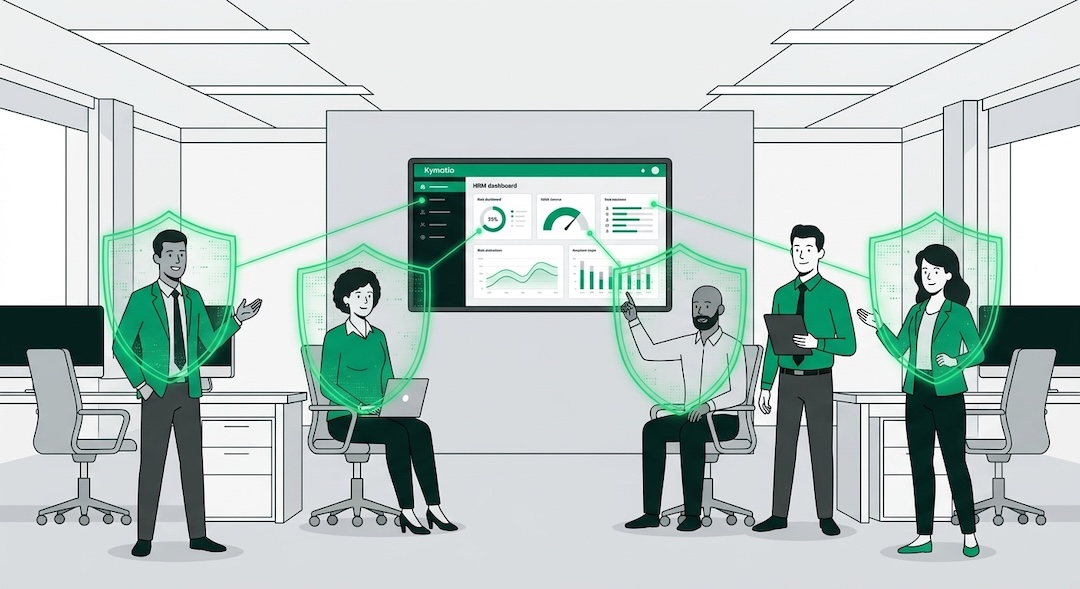
By transforming collaborators into a Human Firewall, the organization activates a proactive defense network. Kymatio delivers this through:
- Vishing and phishing simulations: Practical training against voice and email attacks to automate defensive responses.
- Account Breach Scanner (ABS): Monitoring the dark web to identify compromised collaborator accounts.
- Human Risk Scoring: Real-time visualization of risk heatmaps for strategic decision-making.
Conclusion
Identity and behavior management are the only barriers capable of stopping attackers who no longer need to hack systems—they just need to log in.
Move from reactive activity to real risk management. Request a Kymatio demo and evaluate the resilience of your collaborator network today.
Frequently Asked Questions





Join the Kymatio® newsletter and get the latest insights, research, and practical tips on cybersecurity awareness prevention straight to your inbox.